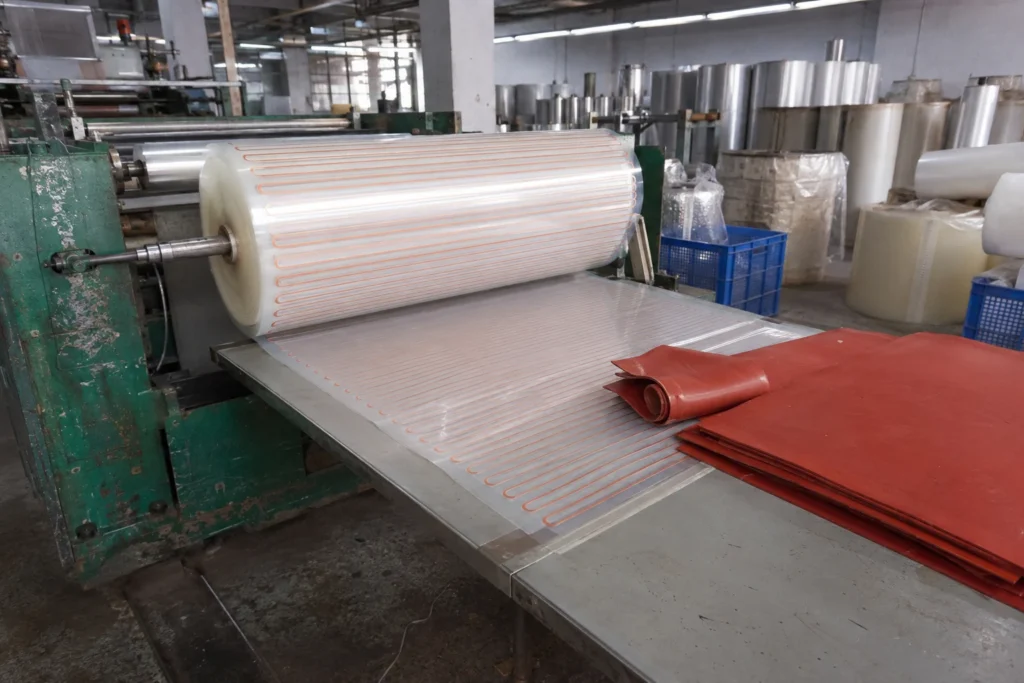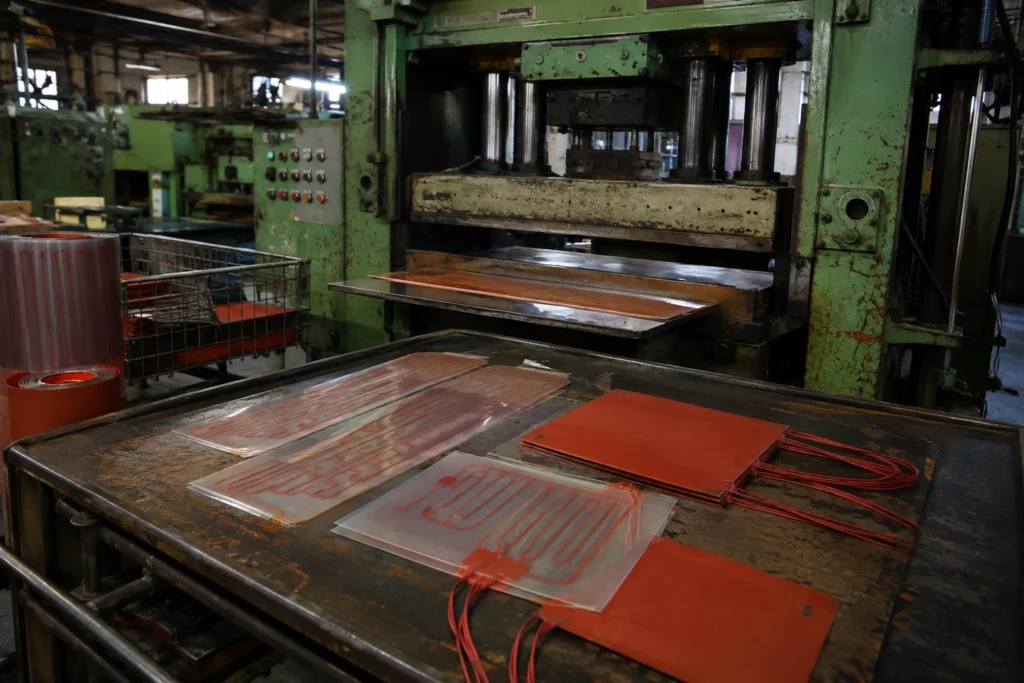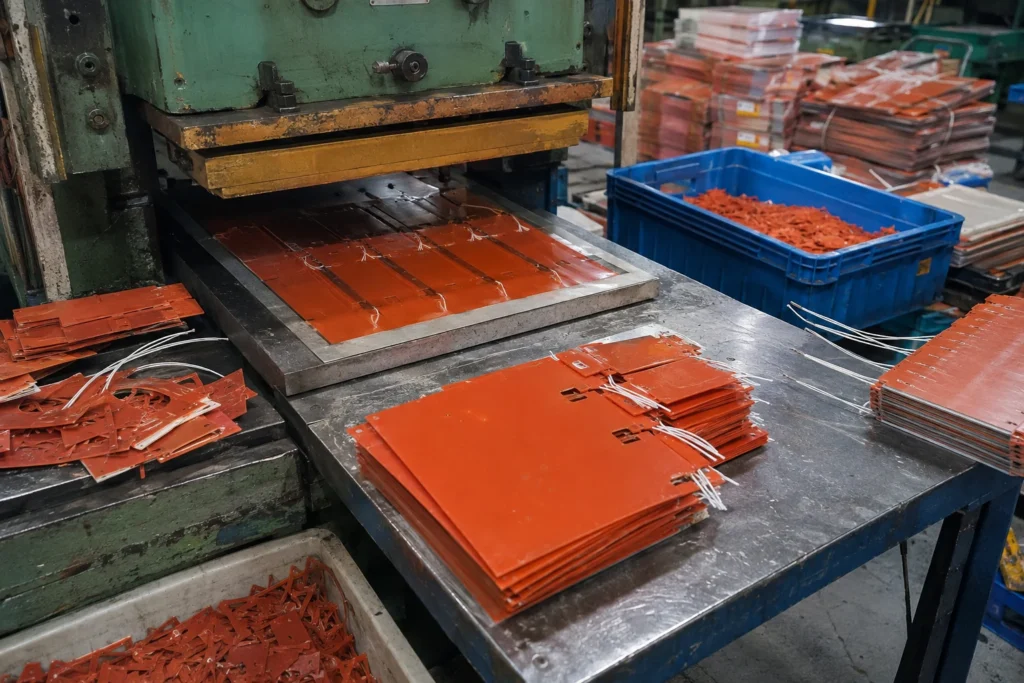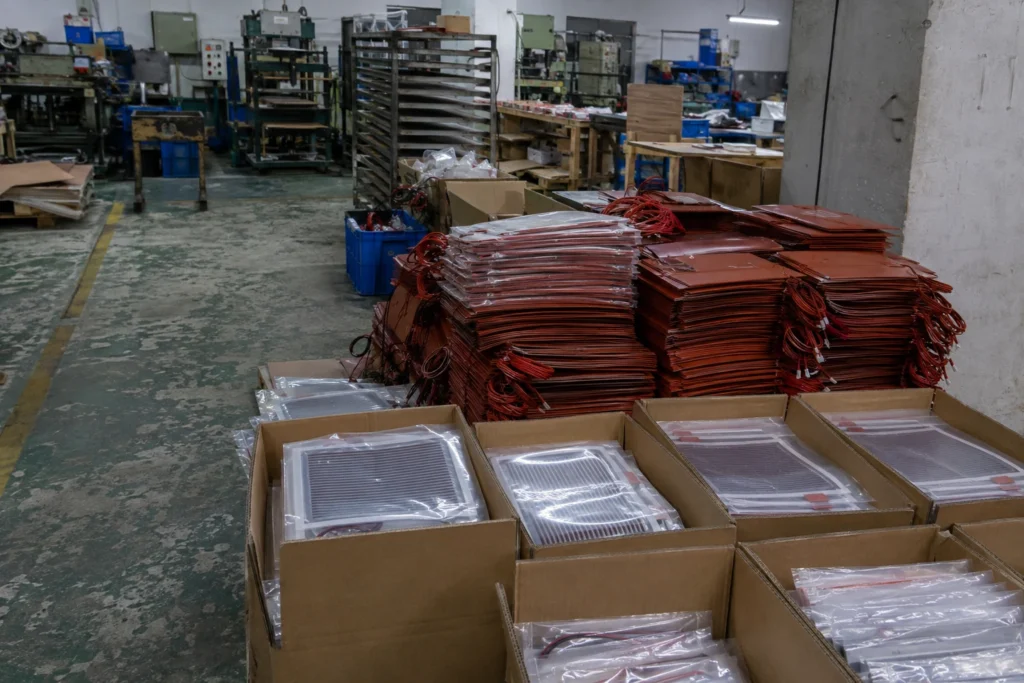
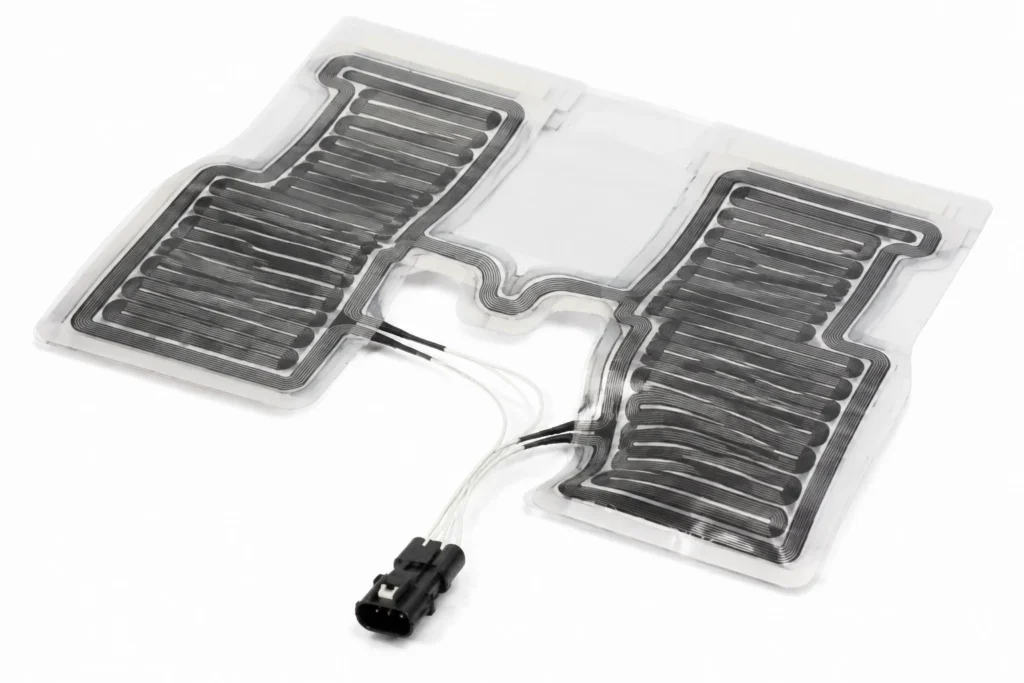
Certification page for seat heating pet film elements under UL 94 V-0. A flammability rating for the plastic materials in the construction — self-extinguishing within 10 seconds with no flaming drips.
UL 94 V-0 — Scope
A flammability rating for the plastic materials in the construction — self-extinguishing within 10 seconds with no flaming drips.
What UL 94 V-0 Does Not Cover
It is a material rating, not a product approval, and says nothing about the heater as an assembly.
This is the division of labour to carry away from any heating standard: safety standards decide whether the part can hurt somebody, and say nothing about whether it holds a temperature, lasts five years or matches the last batch. Performance is a specification you write; safety is one the standard writes.
A flammability rating applies to a material specimen of a stated thickness, not to the assembly. A heater built entirely from V-0 materials is not a V-0 heater; it is a heater whose materials are rated, which is a useful thing to be able to state and a different claim.
How a Made-to-Drawing Heater Is Certified
A construction is built and tested to a standard. The insulation system, the creepage and clearance distances, the earthing, the lead anchorage, the temperature under fault and the marking are what the test covers — and all of those are properties of the construction rather than of the outline it is die-cut to.
So a custom outline does not have a certificate of its own, and no supplier can honestly hand you one. What is available is the construction file: the standard the build is tested to, the materials list with their own ratings, and the test reports. That is what an approvals engineer needs, and it is what the end product's own certification is built on.
The practical consequence: name UL 94 V-0 on the enquiry, not after approval. A construction chosen for cost and then asked to pass a standard afterwards usually has to be rebuilt, because the insulation thickness, the creepage distances and the lead anchorage are decided at design time and are not adjustable later.
From the capability table: IEC/EN 60335, UL 94 V-0, RoHS, REACH, CE, IATF 16949.
What a Seat Heating PET Film Elements Is
Carbon film elements shaped to a seat cushion and backrest, perforated for breathability and terminated for an automotive harness.
Carbon or silver ink screen printed onto PET polyester film, laminated and die cut. It is made on a roll, which makes it the cheapest heater per square metre by a wide margin at volume, and it stops at 120 °C because the film does. Automotive elements are built at very low watt density over a large area — a seat pad or a mirror face — where comfort, not process temperature, is the duty.
The heat leaves through the bonded face. Everything that is not in contact with the load radiates and convects from the back of the heater instead, which at these thicknesses is a poor path — so an air gap under part of the outline is not a small loss of efficiency, it is a hot spot at that spot.
| Element | screen-printed carbon or silver ink |
|---|---|
| Insulation system | PET polyester film |
| Total thickness | 0.3 mm with facing |
| Maximum size, one piece | 500 x 600 mm per element |
| Continuous working temperature | 120 °C |
The continuous limit of 120 °C is set by PET polyester film. The element alloy would run far hotter; it is never the element that decides.
Other Constructions Built to UL 94 V-0
Control and Protection
This heater has no way of limiting its own temperature. Resistance heating draws roughly the same power whatever the temperature, so with the load removed, the fluid gone, the fan stopped or the sensor open circuit, the element keeps producing watts until something stops it.
The design must therefore contain a control device and, separately, a protective one: a controller with a sensor to hold the set point, and a bimetal thermostat or a one-shot thermal cutoff wired in series with the element to open the circuit if the loop ever fails. The two are not interchangeable — a controller that has lost its sensor cannot protect anything, which is exactly the fault the cutoff exists for.
PET softens at about 130 °C and loses its dielectric strength as it does, so the cutoff temperature has to sit under that with margin. This is a construction that cannot be allowed to dry out and overshoot.
Sensors can be built into the part: NTC thermistor, PT100 or PT1000 RTD, or a K-type thermocouple, fitted under the same insulation and tested with the heater as one assembly. A sensor laminated into the heater reads the heater; a sensor on the load reads the load. Both are legitimate, and the drawing has to say which is wanted.
Attachment and Thermal Contact
Attachment options are a factory-applied pressure-sensitive adhesive, vulcanising or bonding to the customer's part, or mechanical clamping with a plate or a strap.
A PSA bond wants a clean, dry, degreased surface, continuous pressure while it wets out, and no trapped air: a bubble under the element is a spot with no thermal path, and it will be the first place the heater fails. Acrylic adhesives reach full strength over 24 to 72 hours, so the assembly is not at its rated watt density the moment it is pressed down.
PET film is dimensionally stable enough to laminate into a trim part, and most automotive elements arrive already bonded to their facing rather than as a loose heater.
From the capability table: PSA backing standard; laminated into the end product at high volume.
The bond line is part of the thermal circuit and should be specified like one. A 0.05 mm acrylic PSA layer conducts roughly 0.2 W/m·K; a filled silicone adhesive is two to five times better, and a bolted joint with an interface pad better again. Whatever is chosen, it has to be continuous — the heater cannot spread heat sideways to cover a gap, and the temperature under a void rises until something in the stack gives way.
Leads and Terminations
Lead wire as supplied: Crimped or soldered leads, or a printed silver bus bar with a bonded tail. Length, gauge, exit position and termination are drawing items — the exit position in particular, because it decides where the heater can be routed and it cannot be changed after the tool is cut.
The lead exit is a thermal discontinuity as well as an electrical one. The joint between a fine element and a stranded lead is the hottest point of many heaters, so it is kept out of the highest watt density zone, strain relieved, and — where the exit sits in a hot area — insulated in PTFE rather than in silicone.
How to Specify One
This is a made-to-drawing part, so there is no catalogue number to quote. A quotation is built from the following, and the more of it that arrives with the enquiry the fewer rounds it takes:
- An outline drawing, or a sketch with dimensions: overall size, holes, cut-outs, radii and the lead exit position.
- The supply voltage, and whether it is AC or DC. The element is wound for one voltage; it is not a switchable range.
- The power required, or — better — the temperature to be reached and the mass or flow it has to be reached in. Given the second, the wattage can be calculated instead of guessed.
- What the heater is attached to, and how. This is what decides which watt density figure applies, and it is the question a quotation cannot proceed without.
- The ambient, and the lowest temperature the assembly must start from. A heater sized for a 20 °C start is undersized for a -30 °C one.
- Duty cycle: continuous, intermittent, or a warm-up to a deadline. Time to temperature is a specification, not a by-product.
- Sensor and protection: which sensor, where it goes, and which limit device is fitted in series with the element.
- The certification the end product is built to, named on the enquiry rather than after approval.
- Quantity and target price, because the construction that is right for fifty pieces is often not the one that is right for fifty thousand.
- Whether adhesive backing is wanted, and what surface it goes onto — a low-energy plastic needs a different adhesive from bare aluminium.
Lead time: Samples 7-10 days from approved drawing; production 15-20 days.
Seat Heating PET Film Elements — Capability Table
These are process limits for the construction, not the specification of one stocked item. Every line is what the factory can hold; what your part holds is fixed on your drawing.
| Parameter | Specification | Limit / note |
|---|---|---|
| Construction | Carbon ink on PET, perforated, with a non-woven face | Decided at quotation from the outline and the wattage |
| Insulation system | PET polyester film, 0.05 mm to 0.125 mm per face | This is what sets the temperature limit, not the element |
| Total thickness | 0.3 mm with facing | Nominal, before adhesive; add 0.2 mm for PSA backing |
| Minimum size | 20 x 20 mm | Below this the element cannot be routed with a safe edge margin |
| Maximum size, one piece | 500 x 600 mm per element | Larger areas are supplied as tiled zones with separate circuits |
| Dimensional tolerance | u00b11 mm on the die-cut outline | On the die-cut outline; hole positions are held tighter |
| Supply voltage | 12 V, 24 V | Wound to the ordered voltage u2014 it is not a switchable range |
| Resistance tolerance | u00b110% standard, u00b15% on request | Measured at 20 u00b0C; hot resistance differs with the element alloy |
| Watt density, free air | 0.05 W/cmu00b2 typical | Nothing conducting heat away u2014 the honest figure for an unbonded heater |
| Watt density, bonded to heat sink | 0.25 W/cmu00b2 maximum | Only valid with full-area contact to metal; specifying at this figure and running in free air destroys the heater |
| Continuous working temperature | -40 u00b0C to +120 u00b0C continuous | Of the heater itself, measured at the element, not the ambient |
| Dielectric strength | 1500 V AC, 1 minute | One minute, element to any exposed surface, no breakdown |
| Insulation resistance | greater than 100 Mu03a9 | At 500 V DC, measured after the dielectric test |
| Lead wire | Crimped or soldered leads, or a printed silver bus bar with a bonded tail | Length, gauge and termination to your drawing |
| Attachment | PSA backing standard; laminated into the end product at high volume | Adhesive-backed heaters need continuous contact pressure while curing |
| Sensor and control options | NTC 10K B3950 bonded to the film, or a printed PTC ink track | Fitted under the same insulation and tested as one assembly |
| Certifications available | IEC/EN 60335, UL 94 V-0, RoHS, REACH, CE, IATF 16949 | Constructions are built to these; the certificate covers the construction, not every outline |
| Comfort target | Surface at 35 u00b0C to 40 u00b0C within 3 minutes | A seat heater is a comfort device u2014 the specification is the time to comfort, not the wattage |
| Bending fatigue | Survives 100,000 cushion compression cycles | Which is what a printed element on PET is genuinely good at |
Capability figures are for screen-printed carbon or silver ink on PET polyester film. The +120 °C continuous limit is the film's, and it is a hard limit: PET softens and loses dielectric strength above roughly 130 °C, so this construction is only a candidate where the maximum credible temperature is bounded well below it.