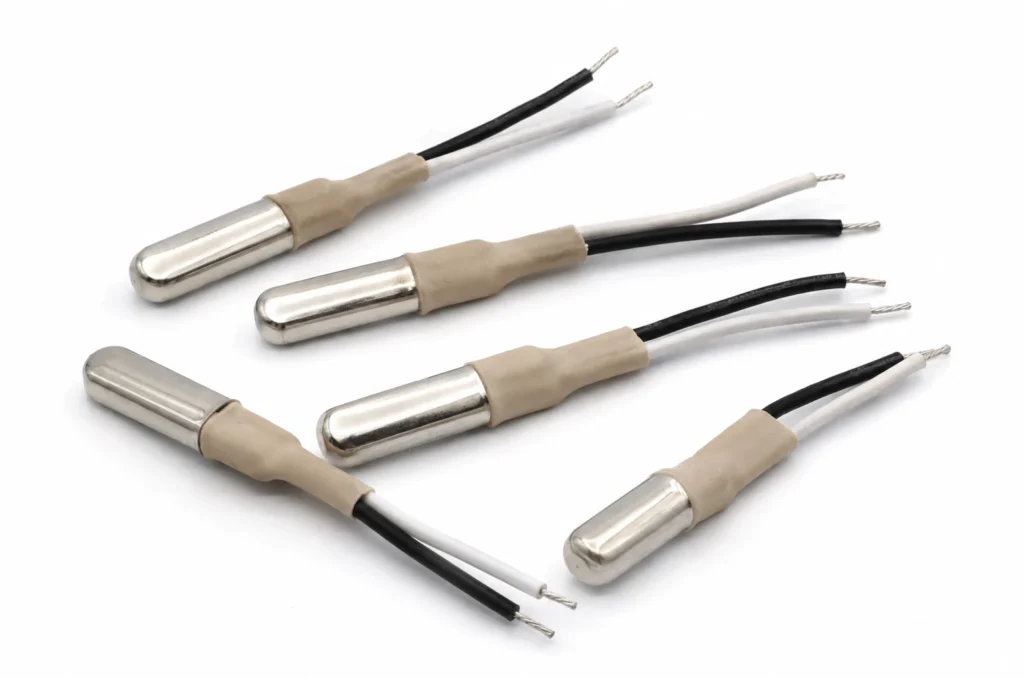
Certification page for ksd9700 bimetal thermostats under RoHS & REACH. Restriction of hazardous substances in the materials and the solder, and declaration of substances of very high concern. Required for anything sold into the EU.
RoHS & REACH — Scope
Restriction of hazardous substances in the materials and the solder, and declaration of substances of very high concern. Required for anything sold into the EU.
What RoHS & REACH Does Not Cover
A compliance declaration, not a safety approval.
This is the division of labour to carry away from any heating standard: safety standards decide whether the part can hurt somebody, and say nothing about whether it holds a temperature, lasts five years or matches the last batch. Performance is a specification you write; safety is one the standard writes.
How a Made-to-Drawing Heater Is Certified
A construction is built and tested to a standard. The insulation system, the creepage and clearance distances, the earthing, the lead anchorage, the temperature under fault and the marking are what the test covers — and all of those are properties of the construction rather than of the outline it is die-cut to.
So a custom outline does not have a certificate of its own, and no supplier can honestly hand you one. What is available is the construction file: the standard the build is tested to, the materials list with their own ratings, and the test reports. That is what an approvals engineer needs, and it is what the end product's own certification is built on.
The practical consequence: name RoHS & REACH on the enquiry, not after approval. A construction chosen for cost and then asked to pass a standard afterwards usually has to be rebuilt, because the insulation thickness, the creepage distances and the lead anchorage are decided at design time and are not adjustable later.
What a KSD9700 Bimetal Thermostats Is
The small snap-action bimetal disc fitted inside most of the heaters in this catalog: it opens at a fixed temperature and closes again when the part has cooled.
A bimetal disc that opens a contact at a fixed temperature. It is not an accurate controller and is not meant to be one: it is the device that decides whether the heater around it survives a fault, and it is specified by its open temperature, its reset behaviour and the current it can break.
The heat leaves through whatever the component is clamped or bonded to; a sensing component adds no heat of its own and simply has to be in thermal contact with the thing it is reporting on.
| Total thickness | Component |
|---|---|
| Maximum size, one piece | Component |
| Continuous working temperature | 150 °C |
The continuous limit of 150 °C is set by the insulation system. The element alloy would run far hotter; it is never the element that decides.
Other Constructions Built to RoHS & REACH
Control and Protection
This heater has no way of limiting its own temperature. Resistance heating draws roughly the same power whatever the temperature, so with the load removed, the fluid gone, the fan stopped or the sensor open circuit, the element keeps producing watts until something stops it.
The design must therefore contain a control device and, separately, a protective one: a controller with a sensor to hold the set point, and a bimetal thermostat or a one-shot thermal cutoff wired in series with the element to open the circuit if the loop ever fails. The two are not interchangeable — a controller that has lost its sensor cannot protect anything, which is exactly the fault the cutoff exists for.
Attachment and Thermal Contact
A sensing component is fitted where it will read the temperature that matters: against the element for a limit device, against the load for a control device. The two positions give different numbers, and choosing the wrong one is the commonest reason a correctly built loop holds the wrong temperature.
From the capability table: Vulcanised inside the heater, bonded to the plate, or bolted.
A sensor reads its own junction, not the surface it is near. Bed it in thermal compound, clamp it, or pot it into the assembly: an air gap of a tenth of a millimetre between a thermistor and the plate it is supposed to be measuring is worth several degrees of error, and it is an error the controller cannot see.
How to Specify One
This is a made-to-drawing part, so there is no catalogue number to quote. A quotation is built from the following, and the more of it that arrives with the enquiry the fewer rounds it takes:
- The temperature to be sensed or switched, and the tolerance the application actually needs.
- Where the component sits — against the element, in the potting, on the load, or in the airflow.
- The electrical duty: for a switching device, the voltage, the current and whether the load is AC or DC.
- Lead length, insulation and termination, and whether the component is fitted by us into a heater assembly or supplied loose.
- The standard the end product is certified to, so the component chosen is one that fits inside that approval.
Lead time: Samples 7-10 days from approved drawing; production 15-20 days.
KSD9700 Bimetal Thermostats — Capability Table
These are process limits for the construction, not the specification of one stocked item. Every line is what the factory can hold; what your part holds is fixed on your drawing.
| Parameter | Specification | Limit / note |
|---|---|---|
| Type | Snap-action bimetal disc, normally closed or normally open | Normally closed is the protective configuration |
| Open temperature | +40 u00b0C to +150 u00b0C in 5 u00b0C steps | Fixed at manufacture u2014 it is not adjustable |
| Tolerance | u00b15 u00b0C standard, u00b13 u00b0C selected | On the open point, measured rising |
| Reset differential | 15 u00b0C to 25 u00b0C below the open point | Wide differential is deliberate: it stops the contact chattering |
| Switching rating | 5 A at 250 V AC resistive | Resistive only u2014 a heater is a resistive load, which is why this rating applies |
| Life | 10,000 cycles at rated load | Far more at a fraction of the rating |
| Mounting | Vulcanised inside the heater, bonded to the plate, or bolted | It must read the part it is protecting, not the air near it |
| Certifications | UL, VDE, CQC on the component | Component approval carries into the heater assembly file |
Figures are the published tolerance and rating bands of the standard sensor and control components fitted to these heaters. Sensor tolerance classes follow IEC 60751 for RTDs and IEC 60584 for thermocouples; thermostat and thermal cutoff ratings are the component manufacturers' own.