Supply voltage page for finned ptc air heaters at 220-240 V AC. European, Chinese and most Asian mains. For the same wattage the element is a much finer, longer conductor than a 24 V one, which is what makes high-voltage low-wattage heaters the hardest to build reliably. The arithmetic, the safety class, the switching device and the capability limits are below.
The Element at 220-240 V AC
Two equations do all the work: P = V²/R and I = P/V. At 220-240 V AC, 500 W is 96.8 Ω and 2.27 A.
| Worked example | 500 W at 220-240 V AC |
|---|---|
| Element resistance, R = V²/P | 96.8 Ω |
| Current, I = P/V | 2.27 A |
The span matters more than the example. At 220-240 V AC a 20 W element is 242 Ω and a 500 W element is 96.8 Ω — a factor of twenty-five in resistance, met by changing the conductor cross-section and the length of the path, both of which are constrained by the outline.
At mains voltage the difficulty is the opposite one. Current is modest — 2.27 A for the worked example — but the element is a long, fine conductor, and a low-wattage heater at 220-240 V AC is the hardest thing in this catalogue to build: 20 W means 242 Ω, which is a very long track to fit inside a small outline without the pitch becoming so tight that adjacent runs interact.
Where the arithmetic will not fit the outline, the usual answers are a lower supply voltage with a small power supply behind it, several circuits in series, or a different construction entirely. What does not work is thinning the conductor further: the track becomes the fuse.
Isolation, Earthing and Safety Class
220-240 V AC is a mains supply, and the construction is built to match: mains-rated insulation, a protective earth connection or a double-insulated build, and creepage and clearance distances held between the element and any accessible surface.
Leakage current is the figure that surprises people. A large heated area behaves as a distributed capacitance to earth, so a big mains heater has a measurable leakage even when it is perfectly sound, and an RCD protecting several of them can trip on the sum. Where several elements share a circuit, allow for the total.
| Dielectric withstand | 1800 V AC, 1 minute, element to case |
|---|---|
| Insulation resistance | greater than 100 Mu03a9 at 500 V DC |
Every heater is tested to these before it ships, element to any exposed surface. A dielectric test is a pass or a fail, not a measurement — a part that passes at 2500 V is not one that may be run at 2500 V.
What a Finned PTC Air Heaters Is
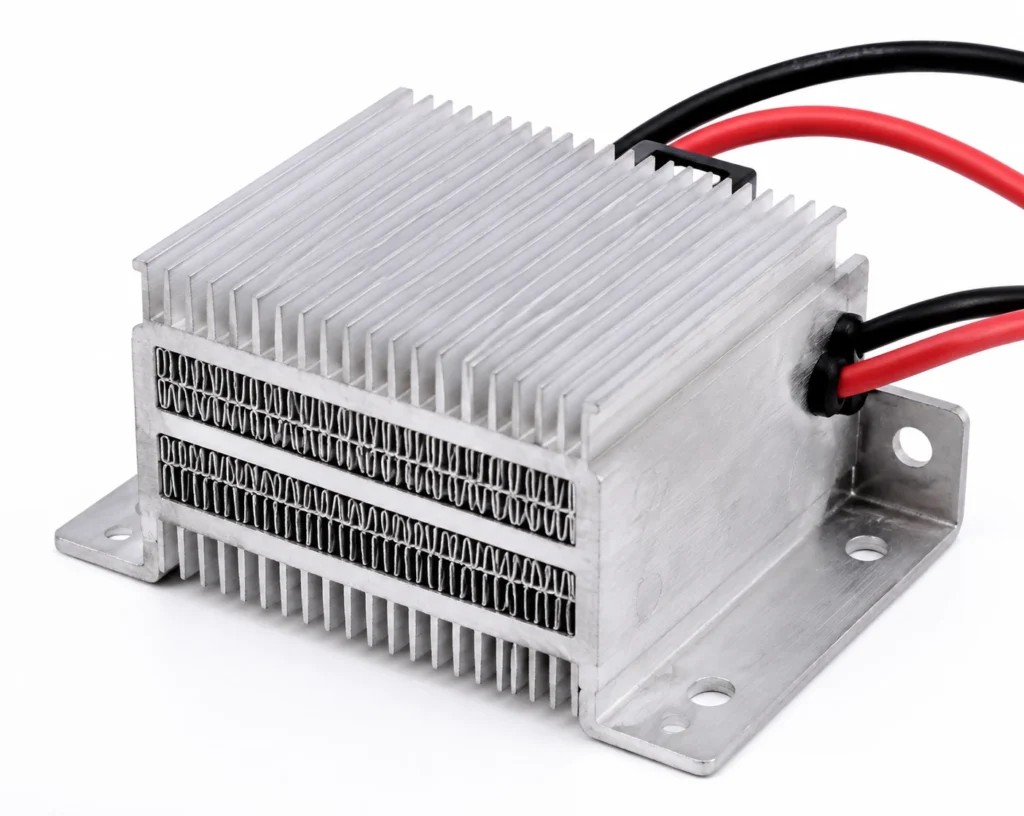
PTC elements bonded into an aluminium fin stack, for warming air in cabinets, dryers, vehicle cabins and enclosures.
Barium titanate ceramic whose resistance rises steeply above its Curie point, so the power it draws falls as the surface approaches that temperature. The element cannot exceed the Curie point it was made to, whatever the supply or the control does. The elements are clamped into an aluminium fin stack: with air moving through the fins the assembly runs cool and draws its rated power, and with the airflow blocked it simply throttles itself back instead of glowing.
The heat leaves through a clamped joint, and a clamped joint is only as good as the pressure and the flatness behind it. A thermal interface material or a thin film of thermal grease fills the gaps that machining leaves; without one, contact happens at the high spots and the element runs hotter than the plate it is bolted to.
| Element | barium titanate PTC ceramic |
|---|---|
| Insulation system | aluminium carrier with insulating film |
| Total thickness | Element 1.5 mm to 3 mm; assembly to your drawing |
| Maximum size, one piece | 50 x 50 mm to 250 x 150 mm frame |
| Continuous working temperature | 250 °C |
The continuous limit of 250 °C is set by aluminium carrier with insulating film. The element alloy would run far hotter; it is never the element that decides.
Switching an AC Element
AC switching has a zero crossing to hide behind. A zero-cross solid state relay makes and breaks at the crossing, which all but removes the switching transient and the conducted emissions that go with it — worth having on any installation that also has to pass an EMC test.
Control by burst firing — whole cycles on, whole cycles off, over a period of a second or more — rather than by phase angle. Burst firing generates almost no harmonics; phase angle control chops the waveform and is the reason a heater ends up in the EMC report at all. A heater has enough thermal inertia that a one-second period is invisible at the surface.
Size the relay for the inrush, not the running current, and heatsink it: a triac or SSR drops around one volt per amp of load, and that is real power to be got rid of inside the panel.
A PTC assembly adds an inrush that the switching device has to survive: cold, the ceramic draws several times its running current until it warms into its regulating region. Rate the device for the cold current, not the hot one.
Watt Density: the Two Figures
Two watt densities are quoted because there are two thermal situations. With nothing conducting heat away, 1 W/cm² is what the insulation survives. Bonded to a heat sink over the full outline, 6 W/cm² is. Anything in between depends on the quality of the joint, and the joint is the customer's to make.
The failure is silent and quick: the element does not know how it is mounted, so at 6 W/cm² in free air the heat simply accumulates in the insulation until it degrades. This is the single most common way these heaters are destroyed, and it happens on the first run rather than after a year.
A PTC assembly behaves differently at the limit. Deprived of its heat sink it does not run away; it reduces its own power. The consequence of a poor thermal path here is a heater that delivers well under its nameplate power, not one that destroys itself.
Leads and Terminations
Termination is specified on the drawing: lead length, gauge, insulation and the connector or tag at the end of it.
Connector and termination options: Faston 2.8/4.8 mm, crimp, or flying leads. A keyed housing removes a soldering operation from the customer's line and removes the possibility of the assembly being connected backwards; on a heater with a separate sensor circuit it also stops the sensor pair being mistaken for the power pair.
The lead exit is a thermal discontinuity as well as an electrical one. The joint between a fine element and a stranded lead is the hottest point of many heaters, so it is kept out of the highest watt density zone, strain relieved, and — where the exit sits in a hot area — insulated in PTFE rather than in silicone.
Control and Protection
This is the one construction here that limits its own temperature. Above the Curie point the ceramic's resistance rises steeply, the current falls, and the element settles rather than climbing — so a PTC heater cannot thermally run away even with the control shorted out.
That is a safety property, not an accuracy one. Self-regulation holds a surface somewhere near the Curie point under whatever cooling it happens to have; it does not hold a set point, and the temperature it settles at moves with airflow, with supply voltage and with the load. Where a number has to be held, a sensor and a controller are still required.
Two things still have to be designed for: the inrush, which is several times the running current while the ceramic is cold and which the supply and any switching device must tolerate, and the electrical fault case, which self-regulation does nothing about — a fuse or a current-limited supply is still the protection against a short.
Which Constructions Are Wound for 220-240 V AC
220-240 V AC is not unique to this construction. In this catalogue it is also wound into:
The supply voltage is wound in at manufacture. A heater built for one voltage cannot be run on another and rated down by arithmetic — at half the voltage it makes a quarter of the power, and at twice the voltage it makes four times the power and destroys itself.
How to Specify One
This is a made-to-drawing part, so there is no catalogue number to quote. A quotation is built from the following, and the more of it that arrives with the enquiry the fewer rounds it takes:
- An outline drawing, or a sketch with dimensions: overall size, holes, cut-outs, radii and the lead exit position.
- The supply voltage, and whether it is AC or DC. The element is wound for one voltage; it is not a switchable range.
- The power required, or — better — the temperature to be reached and the mass or flow it has to be reached in. Given the second, the wattage can be calculated instead of guessed.
- What the heater is attached to, and how. This is what decides which watt density figure applies, and it is the question a quotation cannot proceed without.
- The ambient, and the lowest temperature the assembly must start from. A heater sized for a 20 °C start is undersized for a -30 °C one.
- Duty cycle: continuous, intermittent, or a warm-up to a deadline. Time to temperature is a specification, not a by-product.
- Sensor and protection: which sensor, where it goes, and which limit device is fitted in series with the element.
- The certification the end product is built to, named on the enquiry rather than after approval.
- Quantity and target price, because the construction that is right for fifty pieces is often not the one that is right for fifty thousand.
- The Curie point wanted, and the airflow or thermal path the assembly will have — both decide the power the element will actually deliver.
Lead time: Samples 7-10 days from approved drawing; production 15-20 days.
Finned PTC Air Heaters — Capability Table
These are process limits for the construction, not the specification of one stocked item. Every line is what the factory can hold; what your part holds is fixed on your drawing.
| Parameter | Specification | Limit / note |
|---|---|---|
| Construction | Barium titanate PTC ceramic, electroded on both faces, in an aluminium carrier | Assembly built around the element to suit the load |
| Curie temperature | +80 u00b0C to +250 u00b0C, selected | Selected at order u2014 it is the surface temperature ceiling and cannot be adjusted afterwards |
| Self-regulation | Power falls to a fraction of rated as the surface reaches the Curie point | No thermostat is required to prevent runaway; one may still be wanted for control |
| Element size | 50 x 50 mm to 250 x 150 mm frame | Standard element footprints; assemblies to your drawing |
| Supply voltage | 12 V, 24 V, 110 V, 220 V | The same element works over a voltage band with different output |
| Power output | 1.0 W/cmu00b2 typical in still air, 6.0 W/cmu00b2 with forced air | Output is set by the airflow, not by a setting u2014 this is what self-regulating means |
| Inrush current | 3 to 8 times running current for 1 to 3 seconds | The supply and any relay or MOSFET must tolerate it |
| Dielectric strength | 1800 V AC, 1 minute, element to case | On the assembled unit with its insulation in place |
| Insulation resistance | greater than 100 Mu03a9 at 500 V DC | |
| Terminations | Faston 2.8/4.8 mm, crimp, or flying leads | Chosen for the assembly temperature |
| Life | Over 10,000 hours at rated conditions | Ageing shows as a slow rise in cold resistance, not as sudden failure |
| Certifications available | UL 499, IEC/EN 60335, RoHS, REACH, CE, IATF 16949 | Construction level |
| Airflow | 0.5 to 5 m/s across the fins | Output rises with airflow automatically u2014 the element does the regulating |
| Fan | Axial or blower to your specification, or supplied without | A PTC heater with a failed fan drops its own power instead of burning |
Capability figures are for barium titanate PTC ceramic elements and the aluminium assemblies built around them. The defining property — that power falls steeply as the element approaches its Curie point, so surface temperature cannot run away — is inherent to the ceramic, not a feature of the control.