Working temperature page for ptc aluminium plate heaters at 150 °c to 200 °c. What survives this band, what stops just below it, why the boundary is where it is, and how the temperature is actually measured and held.
What the 150 °C to 200 °C Band Requires
The top of the flexible polymer range. Silicone rubber and polyimide both run continuously at 200 °C; above it both degrade, and no amount of derating changes that.
| Band | 150 °C to 200 °C |
|---|---|
| This construction, continuous | 200 °C |
| Limited by | aluminium carrier with insulating film |
This band reaches the ceiling of the construction. At 200 °C there is no headroom left, so the control has to hold the set point rather than approach it from above, and the limit device has to be set where it can act before the insulation does. A duty that spends its time at the top of the band is a duty that should be quoted against the next construction up.
Why the Boundary Is Where It Is
200 °C is the top of the flexible polymer range. Silicone rubber and polyimide both run there continuously, and both degrade above it — silicone hardens and loses its tear strength, polyimide embrittles. No derating changes either.
Cross this line and the construction changes completely: fired thick film on stainless or alumina, or a mica-insulated element. Those parts are rigid, clamped and made to a different drawing, so the boundary is a redesign rather than a substitution.
What a PTC Aluminium Plate Heaters Is
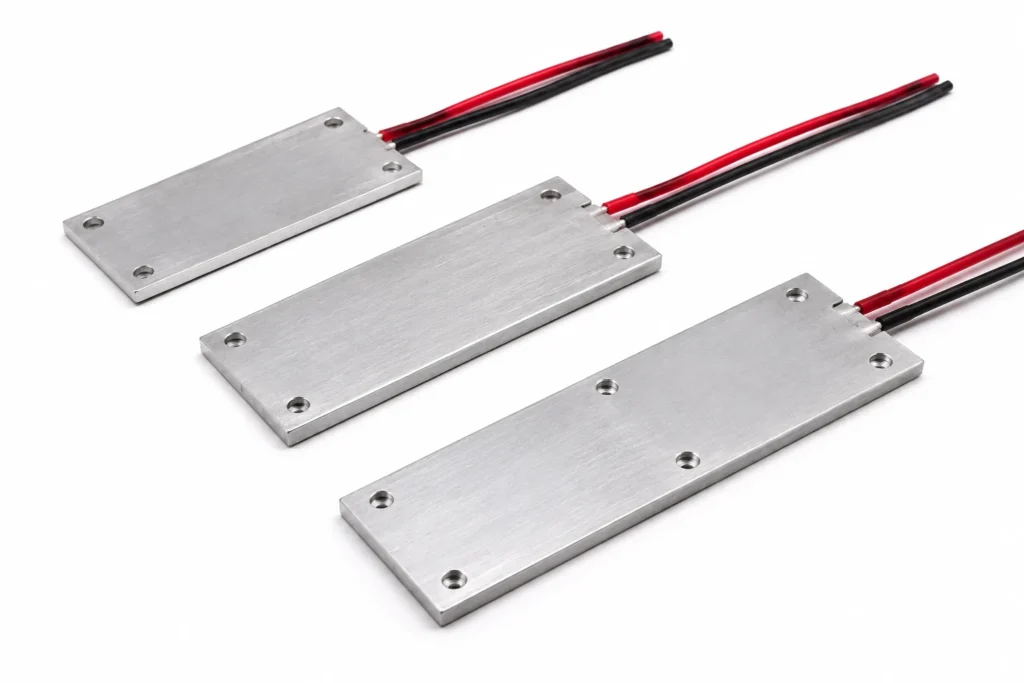
PTC elements bonded to a flat aluminium plate for conduction heating of a surface that must not be allowed to overshoot.
Barium titanate ceramic whose resistance rises steeply above its Curie point, so the power it draws falls as the surface approaches that temperature. The element cannot exceed the Curie point it was made to, whatever the supply or the control does. Bonded to an aluminium plate the ceramic is spread out into a uniform surface, and the plate is also what carries the heat away — an element clamped to nothing regulates itself down to almost no power at all.
The heat leaves through a clamped joint, and a clamped joint is only as good as the pressure and the flatness behind it. A thermal interface material or a thin film of thermal grease fills the gaps that machining leaves; without one, contact happens at the high spots and the element runs hotter than the plate it is bolted to.
| Element | barium titanate PTC ceramic |
|---|---|
| Insulation system | aluminium carrier with insulating film |
| Total thickness | Element 1.5 mm to 3 mm; assembly to your drawing |
| Maximum size, one piece | 40 x 60 mm to 200 x 300 mm |
| Continuous working temperature | 200 °C |
The continuous limit of 200 °C is set by aluminium carrier with insulating film. The element alloy would run far hotter; it is never the element that decides.
Which Temperature Is Being Held
Three temperatures matter and they are not the same number: the element temperature, the temperature of the surface being heated, and the ambient. A heater rated for a continuous working temperature is rated at the element — the hottest point in the assembly, and the one nothing on the outside is measuring.
The gap between element and surface is the thermal path. Bonded to metal it may be a few degrees; across an air gap, a void in the adhesive or a dry clamped joint it can be tens of degrees, and every one of them appears at the element rather than at the load.
Watt Density: the Two Figures
This construction is rated at 0.8 W/cm² in free air and 4 W/cm² bonded over its whole area to metal. The second figure is 5 times the first, and the difference is not a safety margin — it is the heat sink. On a 100 x 150 mm outline, which is 150 cm², that is about 12 W hanging in air against about 6 W bonded down.
Specify at the figure that matches how the heater will actually run. A heater ordered at the bonded density and then switched on before it is attached — on the bench, during a test, after it has lifted off in service — reaches its insulation limit in minutes, because there is nowhere for the heat to go but through the insulation.
A PTC assembly behaves differently at the limit. Deprived of its heat sink it does not run away; it reduces its own power. The consequence of a poor thermal path here is a heater that delivers well under its nameplate power, not one that destroys itself.
Control and Protection
This is the one construction here that limits its own temperature. Above the Curie point the ceramic's resistance rises steeply, the current falls, and the element settles rather than climbing — so a PTC heater cannot thermally run away even with the control shorted out.
That is a safety property, not an accuracy one. Self-regulation holds a surface somewhere near the Curie point under whatever cooling it happens to have; it does not hold a set point, and the temperature it settles at moves with airflow, with supply voltage and with the load. Where a number has to be held, a sensor and a controller are still required.
Two things still have to be designed for: the inrush, which is several times the running current while the ceramic is cold and which the supply and any switching device must tolerate, and the electrical fault case, which self-regulation does nothing about — a fuse or a current-limited supply is still the protection against a short.
How This Construction Fails
- Run at the bonded watt density in free air. The insulation reaches its limit within minutes and the element burns through where the local density is highest. Specify at 4 W/cm² only where the heater is genuinely bonded to metal over its whole area; unbonded, the figure is 0.8 W/cm².
- Inrush that the supply cannot deliver. A cold PTC draws several times its running current; an undersized supply or a small switching device sees that as a fault, and a relay contact welds.
- A poor clamp. The element regulates itself down against a bad thermal joint, so the assembly quietly delivers a fraction of its rated power and the fault reads as a heater that is too small.
Where This Construction Is the Wrong Answer
- Do not plan on running above 200 °C. That ceiling belongs to the insulation system, not to the element alloy, and it is not a figure that derating extends — past it the insulation degrades and the dielectric strength goes with it.
- Do not use self-regulation as a substitute for temperature control where a set point matters, and do not present it as a substitute for a fuse. It bounds the temperature; it does not hold a value and it does nothing about a short circuit.
How to Specify One
This is a made-to-drawing part, so there is no catalogue number to quote. A quotation is built from the following, and the more of it that arrives with the enquiry the fewer rounds it takes:
- An outline drawing, or a sketch with dimensions: overall size, holes, cut-outs, radii and the lead exit position.
- The supply voltage, and whether it is AC or DC. The element is wound for one voltage; it is not a switchable range.
- The power required, or — better — the temperature to be reached and the mass or flow it has to be reached in. Given the second, the wattage can be calculated instead of guessed.
- What the heater is attached to, and how. This is what decides which watt density figure applies, and it is the question a quotation cannot proceed without.
- The ambient, and the lowest temperature the assembly must start from. A heater sized for a 20 °C start is undersized for a -30 °C one.
- Duty cycle: continuous, intermittent, or a warm-up to a deadline. Time to temperature is a specification, not a by-product.
- Sensor and protection: which sensor, where it goes, and which limit device is fitted in series with the element.
- The certification the end product is built to, named on the enquiry rather than after approval.
- Quantity and target price, because the construction that is right for fifty pieces is often not the one that is right for fifty thousand.
- The Curie point wanted, and the airflow or thermal path the assembly will have — both decide the power the element will actually deliver.
Lead time: Samples 7-10 days from approved drawing; production 15-20 days.
PTC Aluminium Plate Heaters — Capability Table
These are process limits for the construction, not the specification of one stocked item. Every line is what the factory can hold; what your part holds is fixed on your drawing.
| Parameter | Specification | Limit / note |
|---|---|---|
| Construction | Barium titanate PTC ceramic, electroded on both faces, in an aluminium carrier | Assembly built around the element to suit the load |
| Curie temperature | +60 u00b0C to +200 u00b0C, selected | Selected at order u2014 it is the surface temperature ceiling and cannot be adjusted afterwards |
| Self-regulation | Power falls to a fraction of rated as the surface reaches the Curie point | No thermostat is required to prevent runaway; one may still be wanted for control |
| Element size | 40 x 60 mm to 200 x 300 mm | Standard element footprints; assemblies to your drawing |
| Supply voltage | 12 V, 24 V, 48 V, 110 V, 220 V | The same element works over a voltage band with different output |
| Power output | 0.8 W/cmu00b2 typical in still air, 4.0 W/cmu00b2 with forced air | Output is set by the airflow, not by a setting u2014 this is what self-regulating means |
| Inrush current | 3 to 8 times running current for 1 to 3 seconds | The supply and any relay or MOSFET must tolerate it |
| Dielectric strength | 1800 V AC, 1 minute, element to case | On the assembled unit with its insulation in place |
| Insulation resistance | greater than 100 Mu03a9 at 500 V DC | |
| Terminations | Faston 2.8/4.8 mm, crimp, or flying leads | Chosen for the assembly temperature |
| Life | Over 10,000 hours at rated conditions | Ageing shows as a slow rise in cold resistance, not as sudden failure |
| Certifications available | UL 499, IEC/EN 60335, RoHS, REACH, CE, IATF 16949 | Construction level |
| Surface temperature | Settles near the Curie point regardless of load | Which is why this is chosen for a surface a person or a plastic part can touch |
Capability figures are for barium titanate PTC ceramic elements and the aluminium assemblies built around them. The defining property — that power falls steeply as the element approaches its Curie point, so surface temperature cannot run away — is inherent to the ceramic, not a feature of the control.