A standard is a set of tests, not a property of a shape. CE Marking is one of the documents ptc immersion and liquid heaters are built to; the sections below say what it fixes, what it does not, and what has to be named on the enquiry for the approval to be usable.
CE Marking — Scope
The manufacturer's declaration that the product meets the applicable EU directives — for a heater, usually the low voltage and EMC directives together with RoHS.
What CE Marking Does Not Cover
CE is self-declared for most heating products; it is not a third-party approval and should not be presented as one.
This is the division of labour to carry away from any heating standard: safety standards decide whether the part can hurt somebody, and say nothing about whether it holds a temperature, lasts five years or matches the last batch. Performance is a specification you write; safety is one the standard writes.
And it is self-declared for most heating products. A CE mark is a manufacturer's statement that the applicable directives have been met, supported by a technical file — it is not a third-party approval, and any supplier presenting it as one is telling you something about themselves.
How a Made-to-Drawing Heater Is Certified
A construction is built and tested to a standard. The insulation system, the creepage and clearance distances, the earthing, the lead anchorage, the temperature under fault and the marking are what the test covers — and all of those are properties of the construction rather than of the outline it is die-cut to.
So a custom outline does not have a certificate of its own, and no supplier can honestly hand you one. What is available is the construction file: the standard the build is tested to, the materials list with their own ratings, and the test reports. That is what an approvals engineer needs, and it is what the end product's own certification is built on.
The practical consequence: name CE Marking on the enquiry, not after approval. A construction chosen for cost and then asked to pass a standard afterwards usually has to be rebuilt, because the insulation thickness, the creepage distances and the lead anchorage are decided at design time and are not adjustable later.
From the capability table: UL 499, IEC/EN 60335, RoHS, REACH, CE, IATF 16949.
What a PTC Immersion and Liquid Heaters Is
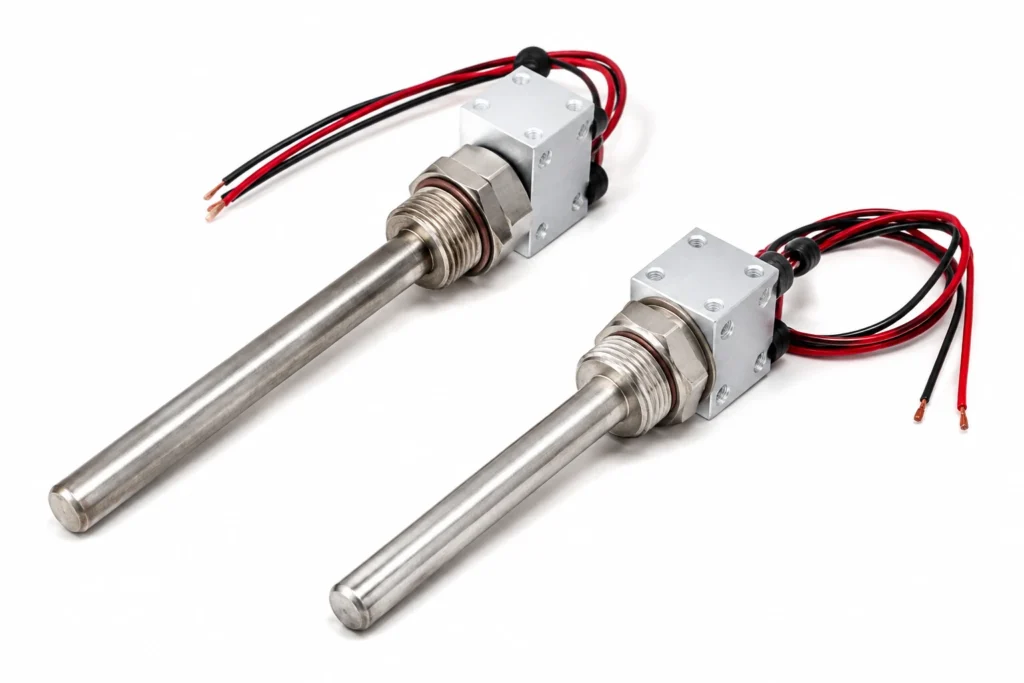
Sealed PTC assemblies for warming water, coolant and washer fluid, where a dry-run cannot be allowed to destroy the heater.
Barium titanate ceramic whose resistance rises steeply above its Curie point, so the power it draws falls as the surface approaches that temperature. The element cannot exceed the Curie point it was made to, whatever the supply or the control does. In a sealed probe the Curie point is chosen below the boiling point of the fluid, so a dry tank stops the heater rather than destroying it.
The heat leaves through the wetted wall into the fluid. That path is excellent while the fluid is there and disappears entirely when it is not, which is why the dry-run case, not the running case, sets the design.
| Element | barium titanate PTC ceramic |
|---|---|
| Insulation system | aluminium carrier with insulating film |
| Total thickness | Element 1.5 mm to 3 mm; assembly to your drawing |
| Maximum size, one piece | M16 to M24 thread, 60 mm to 200 mm immersion |
| Continuous working temperature | 150 °C |
The continuous limit of 150 °C is set by aluminium carrier with insulating film. The element alloy would run far hotter; it is never the element that decides.
The Other Standards This Construction Is Built To
A heater is rarely governed by one document. This construction is also built and tested to:
Safety, materials, substances and quality system are four separate questions with four separate documents behind them. A part can satisfy all four and still be the wrong heater for the duty, which is what the rest of this page is about.
Control and Protection
This is the one construction here that limits its own temperature. Above the Curie point the ceramic's resistance rises steeply, the current falls, and the element settles rather than climbing — so a PTC heater cannot thermally run away even with the control shorted out.
That is a safety property, not an accuracy one. Self-regulation holds a surface somewhere near the Curie point under whatever cooling it happens to have; it does not hold a set point, and the temperature it settles at moves with airflow, with supply voltage and with the load. Where a number has to be held, a sensor and a controller are still required.
Two things still have to be designed for: the inrush, which is several times the running current while the ceramic is cold and which the supply and any switching device must tolerate, and the electrical fault case, which self-regulation does nothing about — a fuse or a current-limited supply is still the protection against a short.
Watt Density: the Two Figures
This construction is rated at 2 W/cm² in free air and 10 W/cm² bonded over its whole area to metal. The second figure is 5 times the first, and the difference is not a safety margin — it is the heat sink. On a 100 x 150 mm outline, which is 150 cm², that is about 3 W hanging in air against about 15 W bonded down.
Specify at the figure that matches how the heater will actually run. A heater ordered at the bonded density and then switched on before it is attached — on the bench, during a test, after it has lifted off in service — reaches its insulation limit in minutes, because there is nowhere for the heat to go but through the insulation.
A PTC assembly behaves differently at the limit. Deprived of its heat sink it does not run away; it reduces its own power. The consequence of a poor thermal path here is a heater that delivers well under its nameplate power, not one that destroys itself.
Leads and Terminations
Termination is specified on the drawing: lead length, gauge, insulation and the connector or tag at the end of it.
Connector and termination options: Faston 2.8/4.8 mm, crimp, or flying leads. A keyed housing removes a soldering operation from the customer's line and removes the possibility of the assembly being connected backwards; on a heater with a separate sensor circuit it also stops the sensor pair being mistaken for the power pair.
The lead exit is a thermal discontinuity as well as an electrical one. The joint between a fine element and a stranded lead is the hottest point of many heaters, so it is kept out of the highest watt density zone, strain relieved, and — where the exit sits in a hot area — insulated in PTFE rather than in silicone.
How to Specify One
This is a made-to-drawing part, so there is no catalogue number to quote. A quotation is built from the following, and the more of it that arrives with the enquiry the fewer rounds it takes:
- An outline drawing, or a sketch with dimensions: overall size, holes, cut-outs, radii and the lead exit position.
- The supply voltage, and whether it is AC or DC. The element is wound for one voltage; it is not a switchable range.
- The power required, or — better — the temperature to be reached and the mass or flow it has to be reached in. Given the second, the wattage can be calculated instead of guessed.
- What the heater is attached to, and how. This is what decides which watt density figure applies, and it is the question a quotation cannot proceed without.
- The ambient, and the lowest temperature the assembly must start from. A heater sized for a 20 °C start is undersized for a -30 °C one.
- Duty cycle: continuous, intermittent, or a warm-up to a deadline. Time to temperature is a specification, not a by-product.
- Sensor and protection: which sensor, where it goes, and which limit device is fitted in series with the element.
- The certification the end product is built to, named on the enquiry rather than after approval.
- Quantity and target price, because the construction that is right for fifty pieces is often not the one that is right for fifty thousand.
- The Curie point wanted, and the airflow or thermal path the assembly will have — both decide the power the element will actually deliver.
Lead time: Samples 7-10 days from approved drawing; production 15-20 days.
PTC Immersion and Liquid Heaters — Capability Table
These are process limits for the construction, not the specification of one stocked item. Every line is what the factory can hold; what your part holds is fixed on your drawing.
| Parameter | Specification | Limit / note |
|---|---|---|
| Construction | Barium titanate PTC ceramic, electroded on both faces, in an aluminium carrier | Assembly built around the element to suit the load |
| Curie temperature | +80 u00b0C to +150 u00b0C, selected | Selected at order u2014 it is the surface temperature ceiling and cannot be adjusted afterwards |
| Self-regulation | Power falls to a fraction of rated as the surface reaches the Curie point | No thermostat is required to prevent runaway; one may still be wanted for control |
| Element size | M16 to M24 thread, 60 mm to 200 mm immersion | Standard element footprints; assemblies to your drawing |
| Supply voltage | 12 V, 24 V, 110 V, 220 V | The same element works over a voltage band with different output |
| Power output | 2.0 W/cmu00b2 typical in still air, 10.0 W/cmu00b2 with forced air | Output is set by the airflow, not by a setting u2014 this is what self-regulating means |
| Inrush current | 3 to 8 times running current for 1 to 3 seconds | The supply and any relay or MOSFET must tolerate it |
| Dielectric strength | 1800 V AC, 1 minute, element to case | On the assembled unit with its insulation in place |
| Insulation resistance | greater than 100 Mu03a9 at 500 V DC | |
| Terminations | Faston 2.8/4.8 mm, crimp, or flying leads | Chosen for the assembly temperature |
| Life | Over 10,000 hours at rated conditions | Ageing shows as a slow rise in cold resistance, not as sudden failure |
| Certifications available | UL 499, IEC/EN 60335, RoHS, REACH, CE, IATF 16949 | Construction level |
| Dry running | Survives it: output collapses as the surface reaches the Curie point | The single strongest argument for PTC in a liquid application |
| Sealing | O-ring or bonded seal, IP67 at the terminal end | Fluid compatibility is checked at quotation u2014 coolant additives attack some elastomers |
Capability figures are for barium titanate PTC ceramic elements and the aluminium assemblies built around them. The defining property — that power falls steeply as the element approaches its Curie point, so surface temperature cannot run away — is inherent to the ceramic, not a feature of the control.