
PTC Heating Modules with Fan are ptc heaters built to your drawing. This page is the process capability behind them — the sizes that can be pressed, the watt density the construction survives, the temperature the insulation tolerates, the voltages it is wound for — followed by how it is attached, how it is protected, and what a quotation needs from you.
What Are PTC Heating Modules with Fan?
PTC Heating Modules with Fan are ptc heaters. They are specified by rating together with the outline drawing, the wattage or the temperature to be held, and what the heater is bonded to — that last one decides the permissible watt density and is the question a quotation cannot skip. The construction is built and tested to IEC 60335 / UL 499 / RoHS.
Construction & Insulation System
The element is barium titanate ceramic whose resistance rises by orders of magnitude above its Curie point. As the surface warms it throttles its own current, so power falls as it approaches the design temperature and it settles there — with no thermostat, no controller and no software involved. The Curie point is selected at order, from 60 °C to 300 °C, and cannot be adjusted afterwards. The ceramic is bonded into an aluminium carrier or fin stack, which is what turns a small hot element into a useful heated surface. Inrush is three to eight times the running current for the first seconds, and the supply and any switching device have to tolerate it.
Watt Density
In free air, with nothing conducting heat away from it, this construction carries 1.5 W/cm². Bonded over its full area to metal that carries the heat off, it carries 8 W/cm². The second figure is not an upgrade of the first — it is a different operating condition, and a heater ordered at 8 W/cm² and then run unbonded fails within minutes. Divide the wattage you need by the area you have before anything else: if the answer is above the free-air figure, either the area grows or the heater gets bonded down.
Typical Applications
Vehicle cabin and battery heating, control cabinet and telecom enclosure anti-condensation, hand dryers and air curtains, washer fluid and coolant warming, mirror and sensor de-icing — duties where a control failure must not be allowed to become a runaway, and where a blocked fan should make the heater quieter rather than hotter. Read the full application guide for PTC Heating Modules with Fan →
Specifying the PTC Heating Modules with Fan
Most enquiries start from the supply that is already in the machine rather than from a construction. The voltage pages take one supply at a time — 12 V DC, 24 V DC and 110-120 V AC — and set out what the element is wound for at that voltage, the current the leads and the switch have to carry, and where the wattage has to be split across more than one circuit.
The insulation system, not the element, decides how hot this can run and whether it can be bent at all: PTC Barium Titanate Ceramic and Aluminium Plate / Extrusion. Each page states the continuous ceiling that material sets, the dielectric withstand it gives, and what choosing it costs in flexibility or in thickness.
The duty temperature is the figure that rules constructions out rather than ranking them, so it is worth settling early: 120 °C to 150 °C and 150 °C to 200 °C. Each page states what survives that band continuously, and what the margin between the surface temperature and the insulation limit needs to be.
This construction is built and tested to IEC/EN 60335 and RoHS & REACH — worth checking against the standard your own end product is certified under, because a part built to one scope does not automatically satisfy another. For the equipment and duties this construction is actually specified for, see where ptc heating modules with fan are used.
Manufactured in our own plant
This heater is laid out, wound or etched, laminated, cut, tested and imaged in-house. The stages below are where its resistance tolerance, its temperature uniformity and its insulation integrity are actually decided.
-
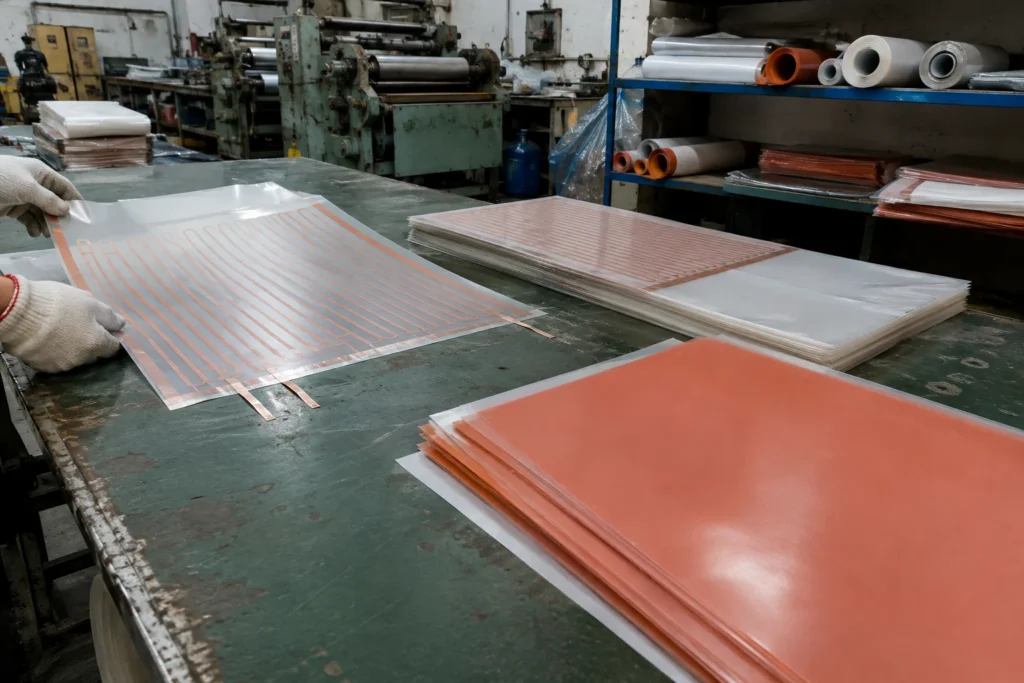
01 Circuit design & material preparation
The customer outline comes in as a drawing or a DXF, and the element is laid out inside it: conductor gauge from the voltage, path length from the resistance, pitch from the watt density wanted at each part of the surface. Where the load needs more heat at the edges than in the middle, that is decided here, in the geometry, not later with more power. The insulation, the foil or wire and the adhesive for that build are then drawn from stock and staged together as one kit.
Calculated resistance and watt density checked against the construction limits before any tooling is cut; every material lot recorded against the works order.
-
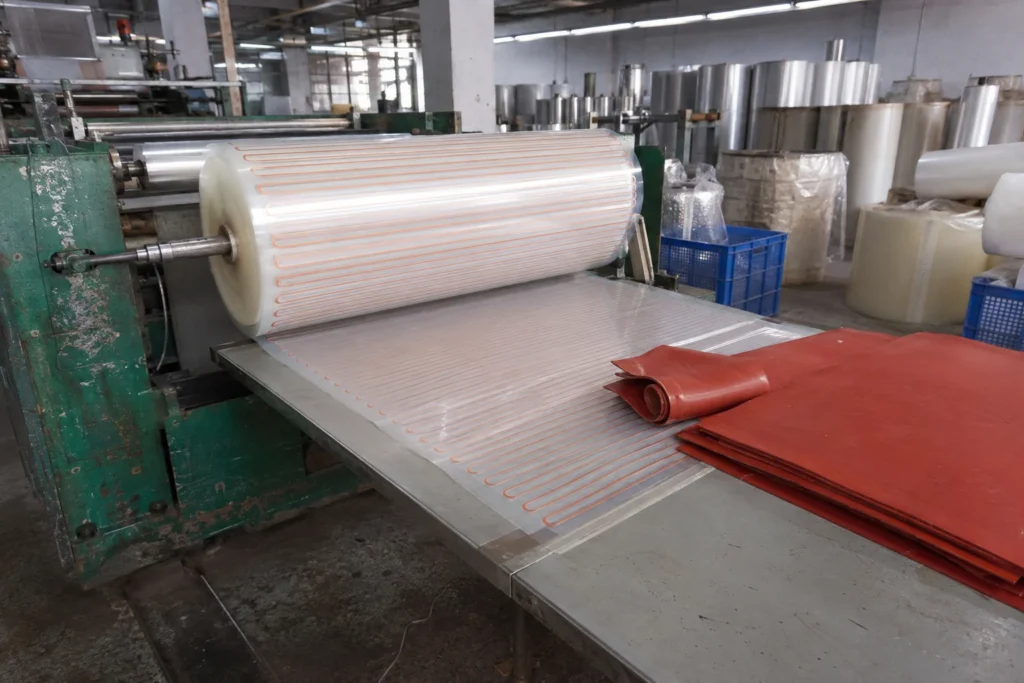
02 Roll feeding & sheet handling
Film and silicone sheet are fed from the roll and cut to sheet, handled flat and kept clean. A fingerprint, a crease or a speck of dust trapped under the insulation becomes a void after pressing, and a void is a place the heat cannot leave from.
Sheet cleanliness and flatness checked at feed; material lot number stays with the sheet through to the finished part.
-
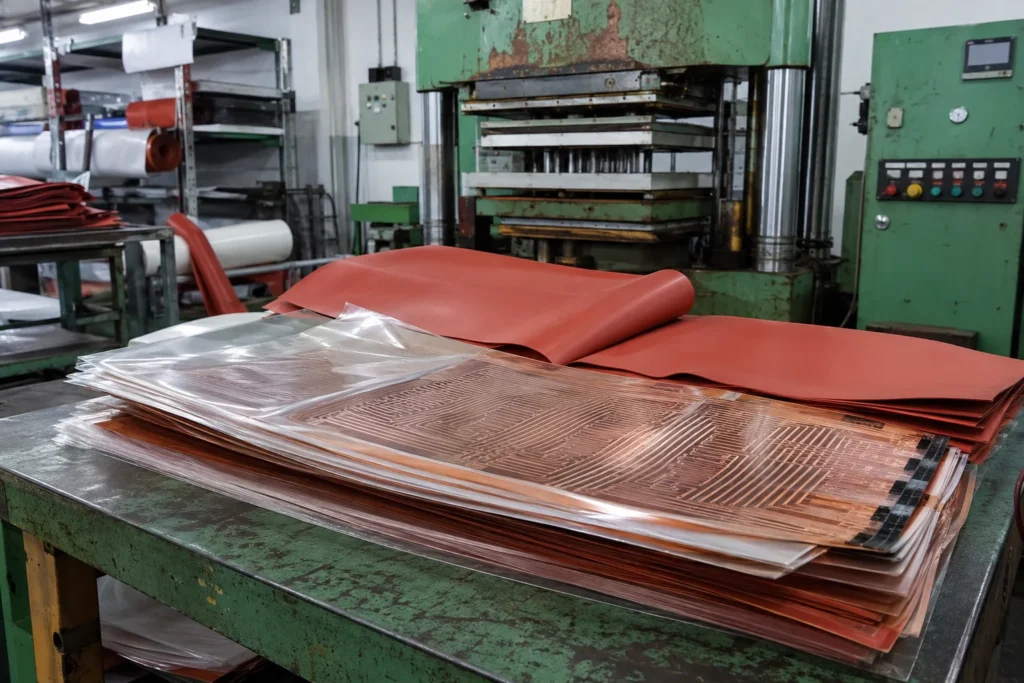
03 Element preparation & lay-up
Wire-wound elements are wound on a glass carrier at the calculated pitch; etched-foil circuits are photo-imaged and etched from Inconel or copper foil to a trace width held within 0.05 mm. That tolerance is what makes the resistance repeatable from lot to lot, which is what makes the temperature repeatable. The element and its sensor are then stacked between the insulation sheets in the order the drawing specifies.
Trace width and element resistance measured before lamination — a circuit out of tolerance is scrapped here, not after it is sealed inside the part.
-
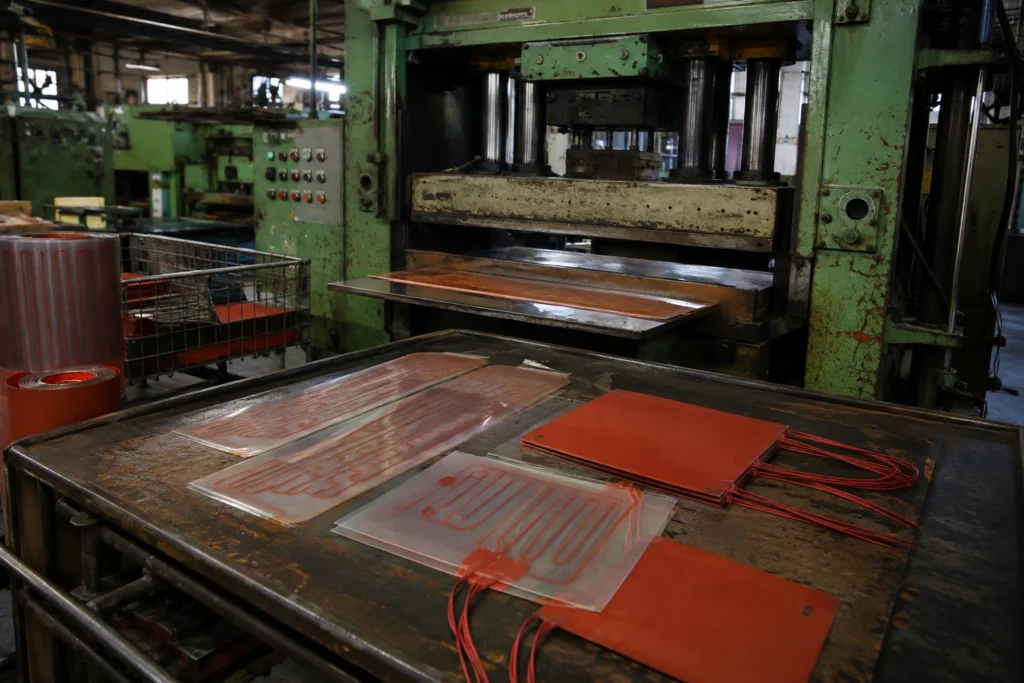
04 Lamination & vulcanising
The lay-up is pressed under heat: silicone is vulcanised, polyimide and PET are laminated with a high temperature adhesive, epoxy plates are potted under vacuum so no voids are left anywhere in the heat path. A void is not a cosmetic defect — it is a place the heat cannot leave from, and it becomes the hot spot that ends the part.
Press temperature, pressure and dwell recorded per lot; potted plates checked for voids.
-
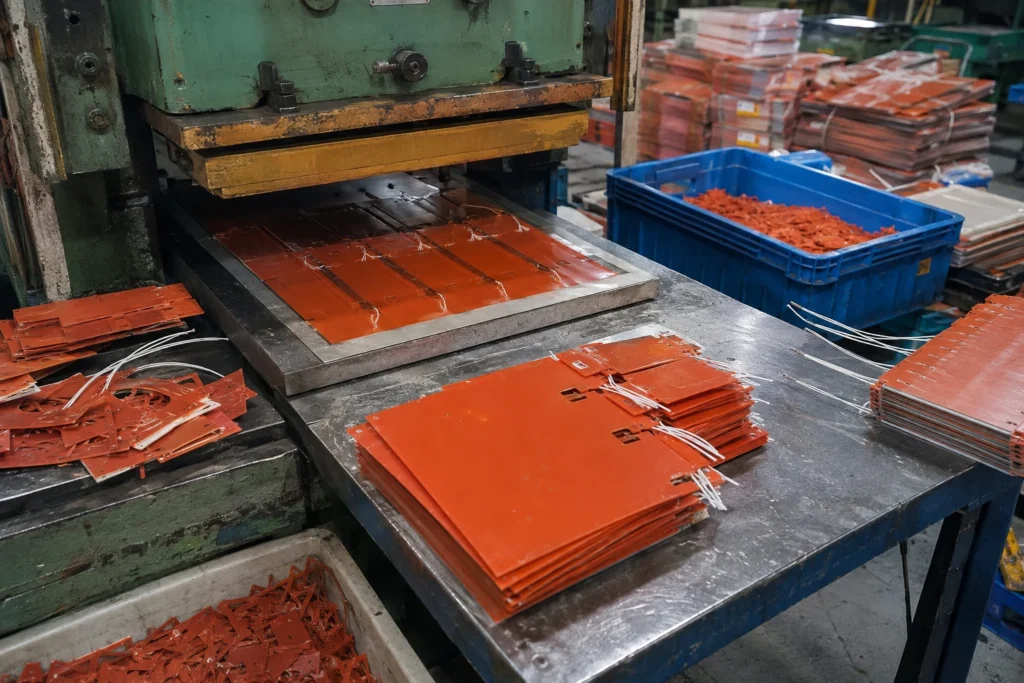
05 Die cutting
The outline is die cut with radiused corners — a die does not cut a sharp inside corner, and a sharp corner in a film is where a tear starts. Cut-outs, sensor windows and mounting holes come out in the same operation, which is why they have to be on the drawing before the tool is made rather than added afterwards.
Outline to ±0.5 mm on film, ±1.5 mm on silicone, gauged against the first-off sample for the tool.
-
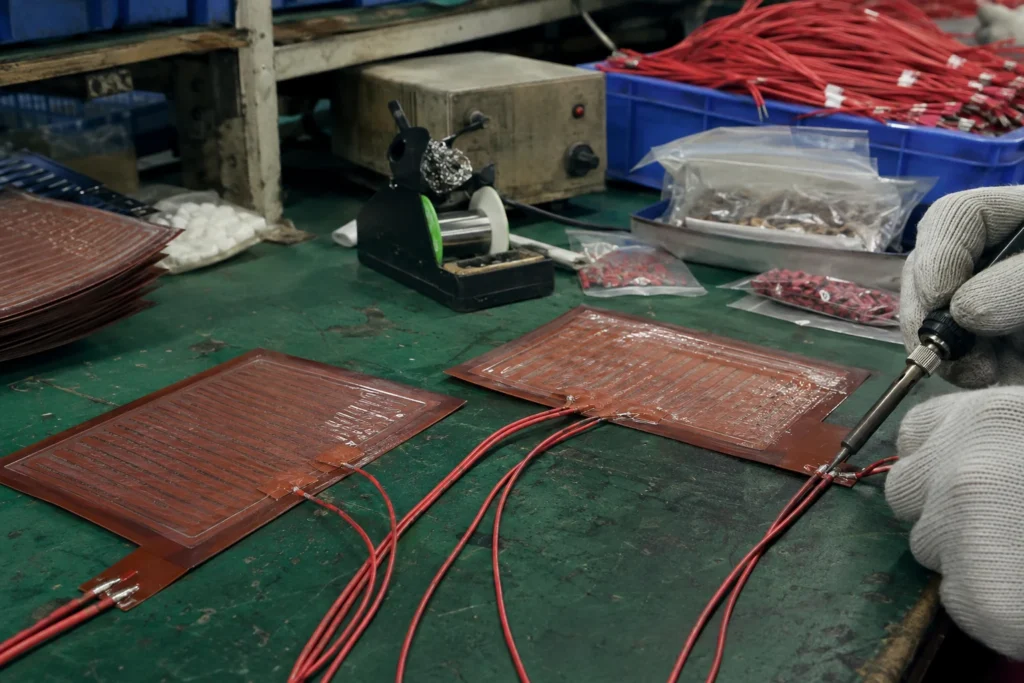
06 Leads, terminals & connectors
Leads are crimped or soldered at the exit and strain relieved, then connectors are fitted to the harness drawing so the assembly line never has to solder. The lead is worth as much attention as the heater: its jacket rating is frequently the lowest temperature limit in the whole assembly, and the exit is where a flexible heater is handled and where it fails if the relief is wrong.
Lead pull-out tested per lot; jacket rating and connector part number checked against the drawing rather than against the last order.