Aramid Paper (Nomex type) is chosen for digital and pid temperature controllers before anything else about the part is decided. A thin, tough, low-cost flexible insulation used where polyimide is unnecessary and silicone is too thick, mostly in transformer and appliance heating. The consequences — thickness, flexibility, what it survives and what it does not — follow below.
Aramid Paper (Nomex type) as an Insulation System
A thin, tough, low-cost flexible insulation used where polyimide is unnecessary and silicone is too thick, mostly in transformer and appliance heating.
| Working range | To +180 °C continuous |
|---|---|
| Total thickness in this construction | Component |
| Maximum size, one piece | Component |
A flexible insulation has to do three jobs at once: hold off the supply voltage, survive the element temperature, and bend without cracking. Thickness trades against all three — a thinner build responds faster and conforms better, and has less material between the element and whatever the heater is touching.
The Temperature Ceiling, and What Sets It
Working range: To +180 °C continuous. The ceiling belongs to the insulation. Nichrome will run red; aramid paper (nomex type) will not, and it is the material around the element that decides what the part is rated at.
This construction is rated 400 °C continuous. That is a continuous figure at the element, not an ambient and not a surface temperature measured somewhere convenient — and it is not a figure that derating extends downwards from something higher. Past the ceiling the insulation degrades, the dielectric strength falls with it, and the failure is electrical rather than thermal.
The boundaries across this catalogue are all material boundaries: PET stops at 120 °C, filled epoxy at 150 °C, silicone rubber and polyimide at 200 °C, and above that only fired and inorganic systems — thick film on stainless or alumina, and mica — are candidates at all.
What Attacks Aramid Paper (Nomex type)
Absorbs moisture, and its dielectric strength falls when it does.
What a Digital and PID Temperature Controllers Is
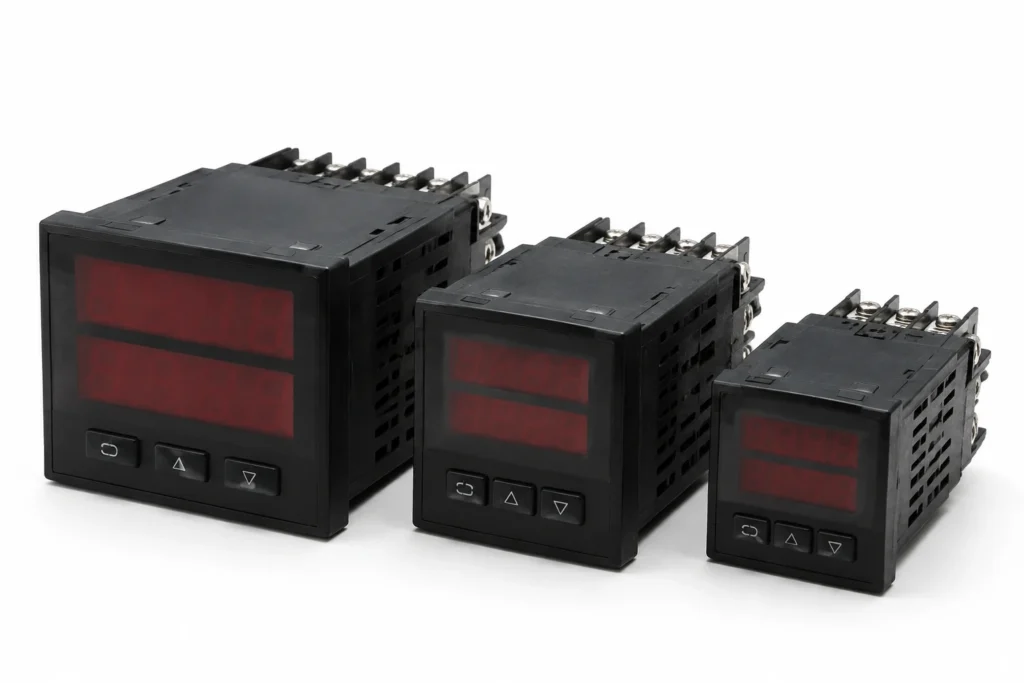
Panel controllers to close the loop around the heater: on/off for simple holding, PID where the set point has to be reached without overshoot.
The instrument that closes the loop: it reads a sensor, compares it with a set point and switches the heater. It is what gives a heating system an accuracy figure — no heater has one on its own.
The heat leaves through whatever the component is clamped or bonded to; a sensing component adds no heat of its own and simply has to be in thermal contact with the thing it is reporting on.
| Total thickness | Component |
|---|---|
| Maximum size, one piece | Component |
| Continuous working temperature | 400 °C |
The continuous limit of 400 °C is set by the insulation system. The element alloy would run far hotter; it is never the element that decides.
Above Its Ceiling: What to Use Instead
Aramid paper is a 180 °C insulation used where polyimide is unnecessary and silicone is too thick. Above it, silicone rubber and polyimide both reach 200 °C; above 200 °C the polymers stop altogether and the construction changes to a fired or mica-insulated one. Its weakness is moisture — it absorbs it, and its dielectric strength falls when it does — so a damp installation is a reason to move to silicone even well below the temperature limit.
Attachment and Thermal Contact
A sensing component is fitted where it will read the temperature that matters: against the element for a limit device, against the load for a control device. The two positions give different numbers, and choosing the wrong one is the commonest reason a correctly built loop holds the wrong temperature.
A sensor reads its own junction, not the surface it is near. Bed it in thermal compound, clamp it, or pot it into the assembly: an air gap of a tenth of a millimetre between a thermistor and the plate it is supposed to be measuring is worth several degrees of error, and it is an error the controller cannot see.
Control and Protection
This heater has no way of limiting its own temperature. Resistance heating draws roughly the same power whatever the temperature, so with the load removed, the fluid gone, the fan stopped or the sensor open circuit, the element keeps producing watts until something stops it.
The design must therefore contain a control device and, separately, a protective one: a controller with a sensor to hold the set point, and a bimetal thermostat or a one-shot thermal cutoff wired in series with the element to open the circuit if the loop ever fails. The two are not interchangeable — a controller that has lost its sensor cannot protect anything, which is exactly the fault the cutoff exists for.
T
h
How This Construction Fails
- Loss of the control loop. An open-circuit sensor, a welded relay contact or a controller in manual leaves the element at full power with nothing watching it — the case the series thermal cutoff exists for, and the reason it must not be omitted to save a part.
- Measuring the wrong thing. A sensor in the air near a heated plate reports the air, and the loop holds the air where the specification wanted the plate. Nothing in the instrument can detect this.
Where This Construction Is the Wrong Answer
- Do not plan on running above 400 °C. That ceiling belongs to the insulation system, not to the element alloy, and it is not a figure that derating extends — past it the insulation degrades and the dielectric strength goes with it.
- Do not rate this component as though it were the heater. It carries a contact rating or a tolerance class; the heater next to it decides the power, the watt density and the temperature the assembly reaches.
How to Specify One
This is a made-to-drawing part, so there is no catalogue number to quote. A quotation is built from the following, and the more of it that arrives with the enquiry the fewer rounds it takes:
- The temperature to be sensed or switched, and the tolerance the application actually needs.
- Where the component sits — against the element, in the potting, on the load, or in the airflow.
- The electrical duty: for a switching device, the voltage, the current and whether the load is AC or DC.
- Lead length, insulation and termination, and whether the component is fitted by us into a heater assembly or supplied loose.
- The standard the end product is certified to, so the component chosen is one that fits inside that approval.
Lead time: Samples 7-10 days from approved drawing; production 15-20 days.
Digital and PID Temperature Controllers — Capability Table
These are process limits for the construction, not the specification of one stocked item. Every line is what the factory can hold; what your part holds is fixed on your drawing.
| Parameter | Specification | Limit / note |
|---|---|---|
| Control modes | On/off, PID with autotune, ramp/soak programmes | On/off is adequate for a lagged mass and hopeless for a thin plate |
| Input | PT100, PT1000, NTC, thermocouple type K/J/T/E | Configurable at the front panel |
| Control accuracy | u00b10.1% of span, u00b11 digit | Of the instrument u2014 the loop is only as good as the sensor placement |
| Output | Relay 3 A, SSR drive 12 V DC, 4-20 mA | SSR drive for anything cycling faster than once a minute |
| Alarms | High, low, deviation, sensor break | Sensor break must fail the heater off, and this should be verified rather than assumed |
| Supply | 100-240 V AC or 24 V DC | |
| Panel size | 48x48, 72x72, 96x96 mm DIN | |
| Standard | IEC 60730 / IEC 61010 | Controller safety and functional standards |
Figures are the published tolerance and rating bands of the standard sensor and control components fitted to these heaters. Sensor tolerance classes follow IEC 60751 for RTDs and IEC 60584 for thermocouples; thermostat and thermal cutoff ratings are the component manufacturers' own.